Check out our White Paper Series!
A complete library of helpful advice and survival guides for every aspect of system monitoring and control.
1-800-693-0351
Have a specific question? Ask our team of expert engineers and get a specific answer!
Sign up for the next DPS Factory Training!
Whether you're new to our equipment or you've used it for years, DPS factory training is the best way to get more from your monitoring.
Reserve Your Seat Today
John Bair

Chris Covington
South Central Communications (SCC), a rural telecommunications provider in Southern Utah, needed to move beyond legacy dry-contact alarming and improve visibility into modern network equipment. SCC standardized on DPS Telecom monitoring by deploying T/Mon LNX for centralized alarm management along with NetGuardian RTUs, enabling both RTU and SNMP-based monitoring and better day-to-day operations.
| Industry | Telecommunications |
|---|---|
| Company Type | Rural telecom and broadband service provider |
| Geography/Coverage | Southern Utah (rural communities served by SCC) |
| Primary Challenge | Replace older monitoring equipment with limited functionality (dry-contact only, no SNMP) and improve reliability and organization of alarming. |
| Solution Deployed | Centralized alarm management with T/Mon LNX plus RTU upgrades using NetGuardian devices to support discrete and analog inputs and integrate SNMP alarms. |
| Key Result | Improved satisfaction with the monitoring system and a clear path to expand SNMP, root alarm filtering, and analog/battery monitoring capabilities. |
| Products Used | T/Mon LNX; NetGuardian 832; NetGuardian 216 |
South Central Utah Telephone Association began offering telephone service to rural areas of Southern Utah in 1953. As the telecommunications industry evolved, SCC expanded beyond traditional telephony.
Today, SCC provides high-speed internet and broadband solutions across the communities it serves, and also delivers fiber optic connectivity to local schools and businesses.
John Bair is a Network Engineer at SCC and Chris Covington is a Central Office Technician.
"Everyone likes it a lot better than the old [equipment]."
In 2010, SCC began integrating DPS Telecom equipment into its existing network. Before that, SCC relied on legacy RTUs and older monitoring gear.
As Bair explained, the original system did not support modern monitoring methods: "It had no SNMP ability. It was all dry contact, discrete-type of alarm points. They were a little bit fickle. We are phasing them out."
In practical terms, SCC needed a monitoring approach that could:
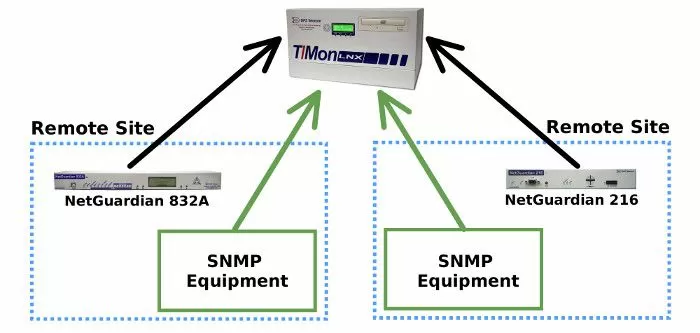
T/Mon can monitor RTUs as well as SNMP-enabled equipment. SCC planned to make better use of the SNMP functionality of their T/Mon unit.
SCC also wanted to move away from older dial-out style notification equipment that could be distracting and unreliable in day-to-day operations. The upgrade effort focused on replacing unsupported or aging components with a unified monitoring strategy that fit modern telecom networks.
SCC selected DPS Telecom to modernize their monitoring architecture and standardize on a central alarm master and RTUs designed for telecom environments. As Bair noted: "Now, we have a T/Mon LNX and two NetGuardian 832s, and a bunch of 216s. We are in the process of getting those installed across our network right now."
This approach lets SCC consolidate alarms from multiple sources into one operational view:
For telecom teams working across central offices and remote locations, this architecture is a common best practice: use site-hardened RTUs for on-site points and a centralized alarm master to unify RTU and SNMP monitoring, accelerate troubleshooting, and reduce time spent chasing intermittent alarms.
While the RTU upgrade increased immediate visibility, SCC planned further improvements as the rollout progressed. Bair described the next stage: "I think the next stage of our implementation will be to make better use of the SNMP manager part of it."
In many networks, SNMP is especially valuable for monitoring modern transport, switching, and IP systems. When T/Mon LNX is configured to ingest SNMP traps and polls, teams can correlate device-level events (like link down, high temperature, or power supply status) alongside traditional RTU alarms (like door, generator, and DC plant conditions). This creates a single pane of glass for both IT and facilities-related events.
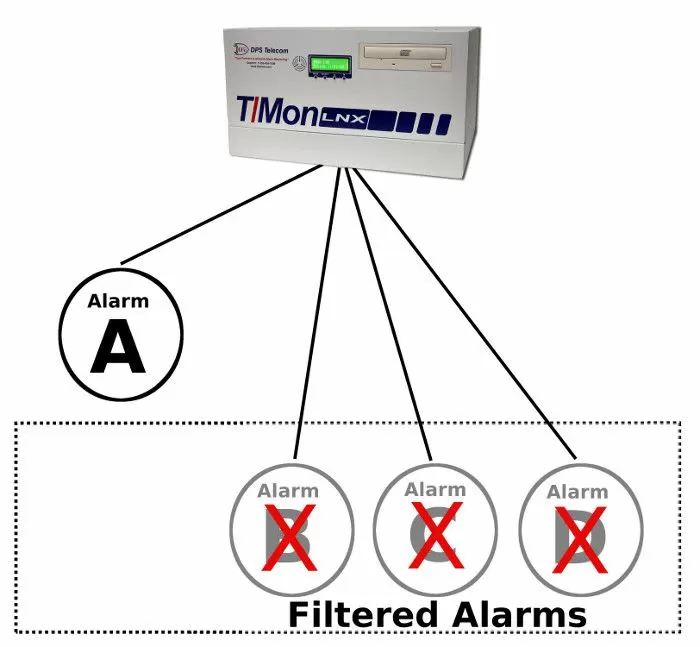
Root Alarm Filtering is an advanced T/Mon feature that helps limit frequent alarms by highlighting the underlying root condition.
To ensure SCC could fully leverage the new system, Bair and Covington attended DPS Factory Training. As Bair summarized: "It was a good blend of theory and hands-on. And we learned some things that we know we need to go back and do. Like some better organization of the alarm points and databasing new equipment."
Training also identified additional monitoring opportunities SCC could implement as their program matures. Bair noted: "Training made me more aware of some of the analog sensors that we maybe should be using and aren't."
"Training made me more aware of some of the analog sensors that we maybe should be using and aren't."
In practice, analog inputs are often used to track values like battery voltage, rectifier current, temperature, and other environmental or power metrics that cannot be represented as a simple on/off alarm. When those values are trended and alarm thresholds are set appropriately, technicians can catch developing issues earlier.
Bair also pointed to advanced features SCC planned to expand: "Some of the advanced functionality such as the root alarming and the SNMP, we haven't used those features to its potential yet so that's something we are looking forward to implementing when we get back."
Factory Training helped highlight features SCC could use immediately to improve monitoring effectiveness and also provided awareness of options for future expansion. "And battery monitoring is something we want to do better. I can see that this could definitely play a role there," said Bair.
SCC replaced older, limited monitoring equipment with a DPS Telecom solution designed for modern telecom operations. The team reported higher satisfaction with the new approach, and SCC established a roadmap to expand SNMP monitoring, better organize alarm point databases, and adopt advanced alarm processing features like root alarm filtering.
By combining NetGuardian RTUs (for on-site discrete/analog points) with T/Mon LNX (for centralized alarm management and SNMP integration), SCC positioned its monitoring program to scale as network equipment and services continue to evolve.
When your network includes both legacy dry-contact points and IP-enabled devices, DPS Telecom commonly recommends pairing NetGuardian RTUs with a T/Mon alarm master so operations teams can standardize alarming across the entire footprint.
SNMP allows IP-enabled devices to report faults and status changes directly to a monitoring system. This helps telecom teams see alarms from routers, switches, transport equipment, and other network elements alongside traditional facilities alarms.
An RTU collects local signals such as door switches, generator status, rectifier alarms, and analog readings, then reports those conditions to a central system. This is especially useful where many alarms are still discrete or analog rather than IP-based.
Root alarm filtering is a method to reduce repeated or cascading alarm noise by emphasizing the underlying condition that is driving secondary alarms. This helps operators focus on the most actionable event.
Discrete alarms answer "on/off" questions. Analog sensors provide continuous values (for example, voltage or temperature), which can be alarmed and trended to identify developing issues such as deteriorating battery conditions.
Training combines hands-on configuration work with best practices for alarm point organization, database management, and feature use (including SNMP and advanced alarm handling), helping teams implement the system more effectively.
If you are replacing aging monitoring gear, expanding SNMP visibility, or standardizing alarming across remote sites and central offices, DPS Telecom can help you design a practical path forward using T/Mon and NetGuardian solutions.
Get a Free Consultation or call 1-800-693-0351 to speak with a DPS Telecom expert about your project.