Check out our White Paper Series!
A complete library of helpful advice and survival guides for every aspect of system monitoring and control.
1-800-693-0351
Have a specific question? Ask our team of expert engineers and get a specific answer!
Sign up for the next DPS Factory Training!
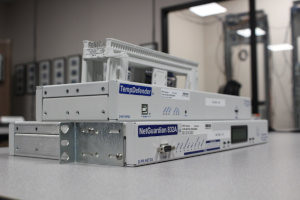
Whether you're new to our equipment or you've used it for years, DPS factory training is the best way to get more from your monitoring.
Reserve Your Seat Today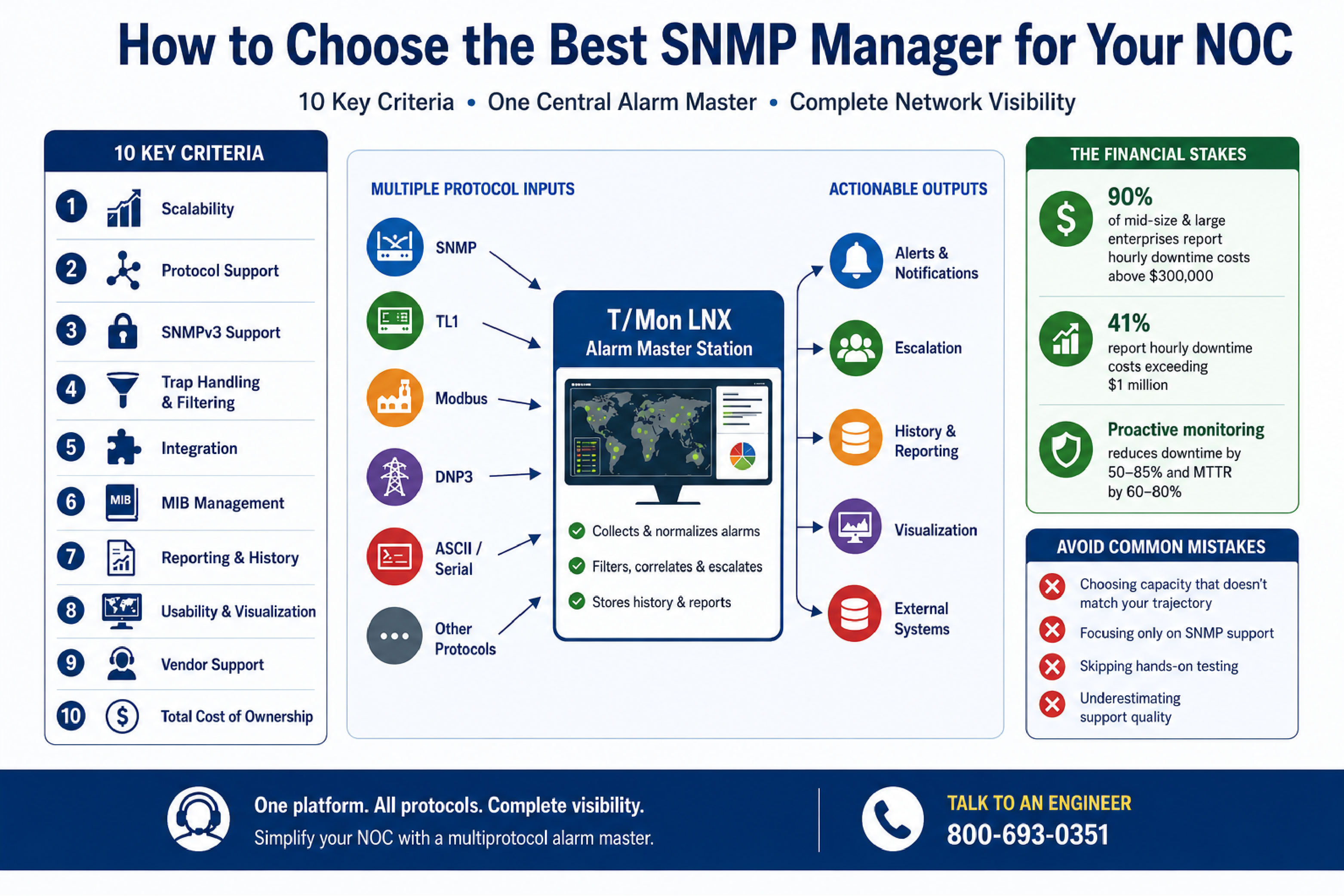
If you're running a NOC with any history to it, you probably already know the frustration of watching SNMP traps roll in from your newer IP gear while a separate screen (or three) covers the TL1 boxes, the Modbus-connected generators, and whatever serial-output equipment has been in service since before anyone on staff started. That fragmented view is the actual problem most teams are trying to solve when they start shopping for an SNMP manager.
The most consistent mistake we see during platform evaluations is narrowing the criteria to SNMP support alone. Most operational networks contain equipment that predates SNMP or runs proprietary protocols alongside it, and a platform that handles only SNMP devices can leave significant blind spots. What most NOCs are really choosing is a central alarm master station that handles SNMP as one protocol among many.
At DPS Telecom, we've spent nearly four decades building alarm monitoring systems for telecom carriers, utilities, and government agencies across more than 1,500 organizations. This guide walks through the ten criteria that matter most when making that choice.
SNMP (Simple Network Management Protocol) is an application-layer protocol first standardized by the IETF in 1988. It enables centralized polling of network devices over IP and supports asynchronous alert delivery via traps when conditions change. An SNMP manager, also called a Network Management Station, queries devices via GET requests, receives TRAP and INFORM notifications, and presents that operational data to NOC staff.
The protocol's primary strength is ubiquity. SNMP runs on virtually every router, switch, UPS, environmental sensor, and wireless access point manufactured today. That vendor-neutral coverage is why SNMP remains foundational in NOCs even as organizations add cloud-based and software-defined infrastructure on top.
Where SNMP managers fall short is protocol breadth. A basic SNMP manager handles SNMP devices only. For telecom operators, utilities, and transportation agencies with equipment deployed over decades, that means running separate monitoring systems for gear that speaks TL1, Modbus, DNP3, ASCII, or any number of other protocols. The result is fragmented visibility, added complexity, and coverage gaps. The practical solution is a multiprotocol alarm master that treats SNMP as one input format among many.
The cost of choosing poorly is concrete. According to ITIC's 2024 Hourly Cost of Downtime Survey, 90% of mid-size and large enterprises report hourly downtime costs above $300,000. For 41% of those organizations, the figure exceeds $1 million per hour.
Proactive monitoring changes those numbers substantially. Industry estimates suggest properly deployed monitoring typically reduces downtime by 50-85% and shortens mean time to repair by 60-80%, with most organizations reporting positive ROI within 6 to 12 months. The global network monitoring market was valued at $4.13 billion in 2025 and is projected to reach $9.52 billion by 2034, which reflects how seriously organizations are treating this infrastructure decision.
Your alarm master needs to handle your current device count without constraining future expansion. Small regional networks may monitor a few hundred devices; large carriers and utilities manage thousands across distributed geographies.
The T/Mon LNX supports up to 9,999 devices and 999,999 alarm points with 1,000 simultaneous TCP/UDP sockets. For smaller operations, the T/Mon SLIM fits into a single rack unit and forwards filtered alarms upstream to a larger T/Mon deployment, creating a natural hierarchical architecture. Tiered capacity options let you right-size the investment today without forcing a migration later.
Most networks contain a mix of modern IP-based equipment and older gear that predates or bypasses SNMP entirely. A manager limited to SNMP forces operators to run separate monitoring systems for devices using TL1, Modbus, TBOS, DNP3, serial ASCII, or any number of other protocols, adding screens, adding overhead, and creating gaps in situational awareness.
As our co-founder Andrew Erickson writes in 100% Uptime: "DPS has always aimed to help you escape this trap with our T/Mon master station. We support legacy and proprietary protocols to bring otherwise incompatible equipment under your monitoring umbrella." Our T/Mon LNX currently handles more than 25 protocols inbound and outbound, from SNMP and TL1 to older proprietary formats including Badger, Cordell, Larse, and Pulsecom, among others.
All three SNMP versions remain in active deployment. SNMPv1 (1988) uses plaintext community strings with no encryption. SNMPv2c (1993) added 64-bit counters and efficient bulk queries but retained the same plaintext authentication. SNMPv3 (1998) introduced user-based authentication via HMAC-MD5 or HMAC-SHA, encryption via DES or AES, and granular access controls through a View-Based Access Control Model.
TechTarget recommends using SNMPv3 exclusively where possible and disabling backward compatibility with v1 and v2c. Your alarm master should support all three versions for backward compatibility with older devices while pushing toward v3 as the standard. For organizations with equipment that cannot natively speak v3, mediation devices can convert v1/v2c traps into encrypted SNMPv3, a practical path for government and military networks where v3 compliance is mandatory.
SNMP traps are asynchronous notifications sent from devices when something goes wrong: a link goes down, a temperature threshold is crossed, a device reboots unexpectedly. Traps provide immediate notification without waiting for the next polling cycle, making them essential for fast incident detection.
Effective trap handling requires several capabilities working together:
Our T/Mon platform includes derived alarms that use Boolean logic to detect combinations of events indicating systemic problems, alongside a scheduling system that routes the right alarm to the right person at the right time via pager, email, or phone.
An alarm master that operates in isolation creates data silos and slows incident response. The platform should export alarm data via SQL, ODBC, or streaming interfaces; support forwarding processed traps to upstream or corporate-level management systems; and connect with IT service management and ticketing platforms.
The T/Mon LNX offers a SQL-based history agent for ODBC-compliant database export compatible with Microsoft Access and Excel, near real-time alarm data streaming, and the ability to forward processed alarms as SNMP traps to higher-level management systems. Integration flexibility matters particularly for organizations where T/Mon sits as a regional aggregator feeding into a larger enterprise NMS.
Management Information Bases (MIBs) are the translation dictionaries that convert raw Object Identifiers (OIDs) into human-readable device metrics. Without the correct MIB loaded, a trap appears as an opaque string of numbers rather than an actionable alert.
Your platform must be able to import and compile vendor-supplied MIBs, support custom enterprise MIBs, and translate OIDs into plain-language descriptions automatically. We maintain a free downloadable MIB library covering equipment from a range of manufacturers, and the T/Mon SNMP Trap Processor module allows operators to compile MIBs directly onto the system and configure how trap data is displayed and categorized.
A strong alarm master maintains a queryable history searchable by date range, severity, device, location, and alarm type. Historical data supports root cause analysis after incidents, post-mortem reviews, and the baseline measurements against which anomalies are detected. Reports should be exportable in formats non-technical stakeholders can use, including PDF and web-based summaries for operations managers and finance teams.
T/Mon stores searchable alarm histories and supports trend analysis through its WebMonitor interface, with on-demand PDF report generation. Historical records serve compliance requirements and also provide the baseline for capacity planning and recurring fault identification.
A platform that requires deep programming background to operate limits who can respond during an incident. We've seen this play out directly. EastLink, a Canadian cable telephony provider, had deployed a conventional SNMP manager and found it too complex for non-technical staff. Jim Bower, EastLink's telecom operations manager, described the challenge: "SNMP managers have an extensive programming background and in order to understand the information, you also needed to have this background. We needed a system that could be understood by someone with a basic telephony background." They switched to our T/Mon platform specifically for its usability and alarm presentation.
Geographic maps, floor plan overlays, and drill-down network views give NOC analysts spatial context for where problems are occurring, without requiring them to parse raw data. T/Mon GFX provides war-room visualization with geographic hierarchy views and real-time status overlays.
The level of support becomes most visible after deployment, when edge cases emerge and configurations need adjustment. A vendor with generic, script-reading support adds delays to every unusual problem.
Our support model is structured differently from most vendors. Technical support is included for the lifetime of the equipment at no additional cost, with 24/7 emergency availability. The engineers who answer support calls are the same people who design our products. If a problem requires deeper expertise, the engineering department is in the same building. We also offer free week-long factory training classes at our Fresno, California headquarters, including meals, and we provide custom engineering at no non-recurring engineering fees.
Evaluate pricing models carefully. Some vendors charge per device or per sensor, which creates pressure to limit monitoring coverage. Others rely on annual maintenance fees that compound over time. Even free open-source tools carry hidden costs in staff training, custom documentation, and infrastructure to run them.
We offer tiered pricing across our product line, from entry-level master station configurations to full T/Mon LNX enterprise deployments. All purchases include a 30-day equipment loaner program so organizations can test in their own racks before committing, plus a 30-day no-risk money-back guarantee.
| Category | What to look for | Why it matters |
|---|---|---|
| Device capacity | Thousands of devices and alarm points | Networks grow; the platform shouldn't be the bottleneck |
| Protocol breadth | SNMP v1/v2c/v3 plus TL1, Modbus, DNP3, ASCII, TBOS, and more | Older and multi-vendor environments need one consolidated view |
| Trap handling | Severity assignment, filtering, deduplication, escalation | Prevents alert fatigue and ensures critical alarms reach the right person |
| MIB management | Import, compile, and auto-translate vendor and custom MIBs | Traps are unreadable without proper MIB support |
| Notifications | Email, SMS, pager, phone with scheduling and escalation chains | The right person must be reachable at the right time |
| Security | SNMPv3, TLS/SSL, role-based access control | Protects the management plane from unauthorized access |
| Reporting | Queryable history, trend analysis, exportable reports | Supports compliance, capacity planning, and post-incident review |
| Visualization | Geographic maps, drill-down views, war-room displays | Spatial context accelerates incident identification |
| Integration | SQL/ODBC export, SNMP forwarding, API access | Connects monitoring data to ticketing and business systems |
| Vendor support | Engineering-staffed support, lifetime coverage, custom solutions | Reduces time to resolution and long-term operational risk |
Several recurring errors surface in the platform selection process:
SNMP isn't going away as networks expand into cloud and software-defined architectures. Most organizations pair SNMP with complementary telemetry sources, including streaming data, log records, and traffic flow metrics, to build a complete operational picture. SNMP functions as a common visibility layer across otherwise fragmented environments, and most modern observability platforms consume SNMP metrics as one input among many.
For NOCs managing this complexity, a multiprotocol alarm master station provides a stable, protocol-agnostic foundation. It handles SNMP polling and trap processing for IP-based devices alongside TL1 for optical and broadband equipment, Modbus for generators and industrial controls, and dozens of other protocols for older infrastructure, all through a single management interface. The consolidation alone eliminates the multiple-screen problem that makes incident triage slower and more error-prone.
If you'd like to see how a multiprotocol alarm master maps to your specific equipment mix, we offer free 15-minute consultations, live product demos, and a 30-day loaner program so you can test before committing.
Talk to an Engineer | 800-693-0351

Andrew Erickson
Andrew Erickson is an Application Engineer at DPS Telecom, a manufacturer of semi-custom remote alarm monitoring systems based in Fresno, California. Andrew brings more than 19 years of experience building site monitoring solutions, developing intuitive user interfaces and documentation, and opt...