Check out our White Paper Series!
A complete library of helpful advice and survival guides for every aspect of system monitoring and control.
1-800-693-0351
Have a specific question? Ask our team of expert engineers and get a specific answer!
Sign up for the next DPS Factory Training!
Whether you're new to our equipment or you've used it for years, DPS factory training is the best way to get more from your monitoring.
Reserve Your Seat Today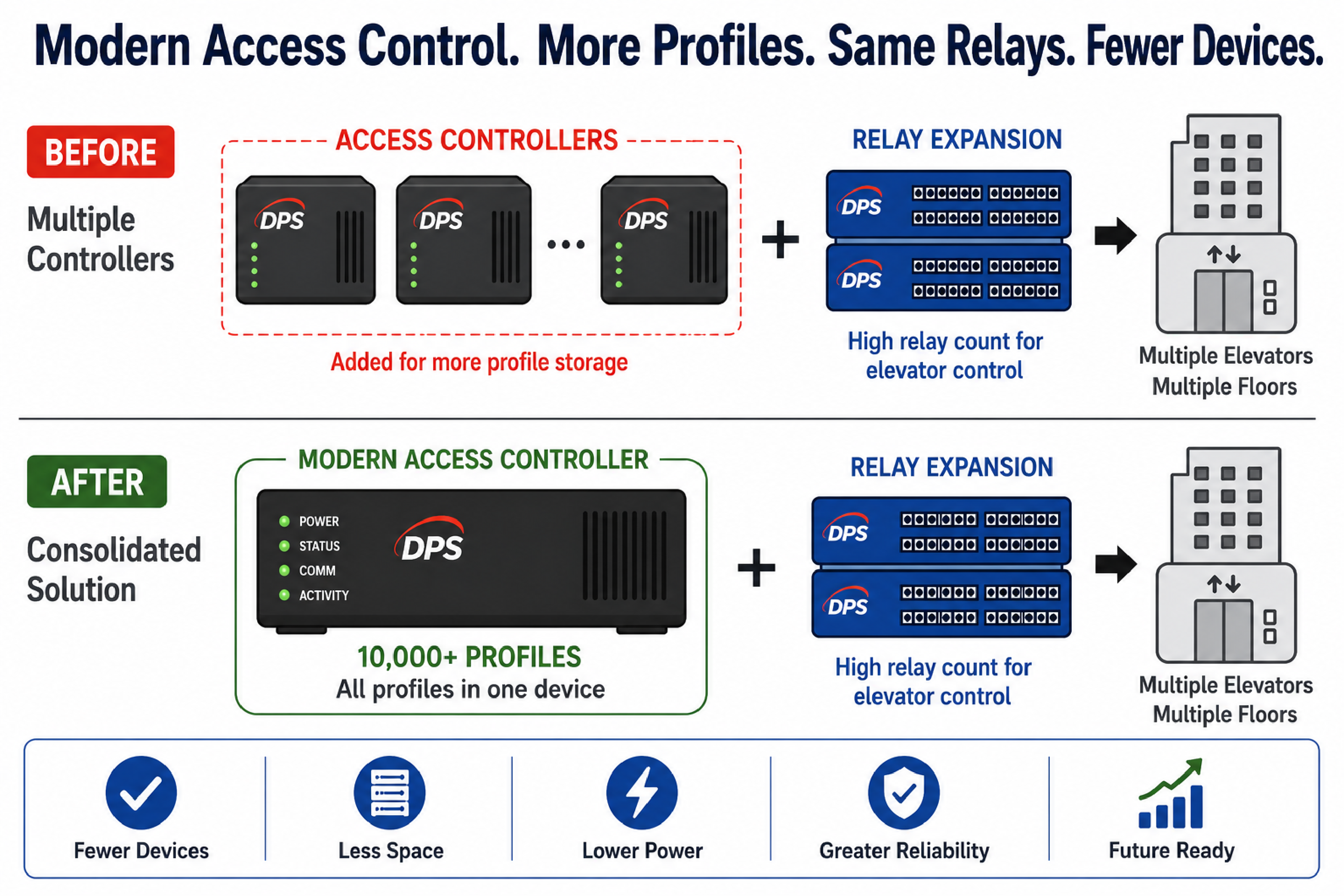
Building access control is the system that decides which badge holders can enter which doors, floors, and elevator cars, and records those events for security. When a deployment grows across many sites and adds elevator floor control, the limiting factor often becomes profile capacity - the number of badge permissions the hardware can store - rather than the number of physical inputs or outputs.
This article explains why elevator access consumes badge profiles so quickly, how profile limits force operators into multi-controller deployments, and how modern access control hardware can consolidate that footprint while keeping the relay capacity elevator control requires. It is written for facilities and IT teams managing badge access across multiple buildings who want to reduce hardware count without losing capability.
Badge profile capacity is the number of distinct access permissions a controller can store, where each profile defines what a credential is allowed to do. A profile is not simply one badge holder; it is a specific set of permissions, and a single person can consume several profiles depending on how their access is structured.
In a door-only system, profile use is modest, because one person usually maps to one access definition. Elevator access changes that math. When permissions are assigned per floor and per elevator car, one badge holder can require multiple profiles to cover every floor-and-car combination they are allowed to use. Across a building with many users, profile consumption climbs far faster than the headcount suggests.
This is why profile capacity, not relay or input count, is frequently the first ceiling an access deployment hits. A controller may have ample physical I/O remaining while its profile storage is already full. Understanding that distinction is the key to sizing access hardware correctly with a building access system.
Elevator access control is the practice of restricting which floors a badge holder can select from inside an elevator car, rather than only controlling building entry. It multiplies profile requirements because access is defined across two dimensions at once: which floors and which cars.
Consider a building with multiple elevators and several controlled floors:
The result is that elevator-heavy sites exhaust profile storage long before they run short of relays or inputs. Older access platforms that topped out near roughly 1,300 profiles could be filled by a single large building's elevator requirements, which is what historically pushed operators toward adding more controllers.
A multi-controller deployment is an installation that uses several access controllers at one site. It is worth distinguishing two very different reasons for doing this, because they lead to different modernization decisions.
| Reason For Extra Controllers | What It Actually Solves |
|---|---|
| Additional I/O (relays and inputs) | More physical control points - more doors, more elevator floor relays. A genuine hardware-capacity need. |
| Additional profile storage | More badge-permission capacity only. The extra controller is there to hold profiles, not to add control points. |
When controllers were added mainly to hold more profiles, the extra hardware was a workaround for a memory limit, not a response to a real I/O need. Each added controller brings its own rack space, power draw, maintenance burden, and potential failure point - cost that exists only because the older platform could not store enough profiles on one device. Recognizing which of the two reasons applies is what tells you whether newer hardware can consolidate the deployment.
Hardware consolidation is the use of a more capable controller to do the work that previously required several, reducing the device count without reducing capability across the access control product line. When the extra controllers existed only to store profiles, a platform with greater memory and processing capacity can absorb that role directly.
A current-generation access controller with substantially more memory can hold far more badge profiles on a single device. That changes the architecture in a specific way:
The outcome is fewer overall devices: less rack space, lower power and maintenance overhead, and fewer points of failure, while preserving the relay density that multi-elevator buildings require. Pairing a modern NetGuardian-based controller with relay expansion is what lets a site keep its elevator control capability on a smaller hardware footprint.
Relay capacity is the number of discrete control outputs available to operate elevator floor enables and door strikes. Elevator floor control is relay-intensive, so consolidating controllers must not come at the cost of the relays those floors require.
This is why relay expansion hardware remains valuable even as profile storage moves to a single modern controller. The expansion units provide the high relay counts that align well with larger elevator access applications, while the controller handles the logic and the now-ample profile storage. The two roles are separated cleanly: the controller provides memory, processing, and profile capacity; the expansion hardware provides the physical relay density.
Designing this split correctly means counting the real relay requirement - floors times the control points each floor and car needs - and provisioning expansion relays for that, rather than adding whole controllers just to reach the relay count. The result matches hardware to the actual physical requirement instead of to a profile-storage limitation.
A coordinated upgrade is one that refreshes related systems together when they are aging on a similar timeline. Access control often reports to a central monitoring master, and when both are due for modernization, addressing them as one initiative can be more efficient than two separate projects.
An aging central T/Mon alarm master can be refreshed onto current hardware - a modern Linux build, solid-state storage, and an enterprise operating-system option for security-sensitive environments - at the same time the access controllers are modernized. Handling both in one initiative aligns the planning, the budgeting, and the cutover, and it gives staff a single window to get familiar with the updated systems, supported by periodic factory training. Whether to combine them depends on the condition and maintenance status of each, but when both are aging, a broader upgrade is worth evaluating rather than refreshing one and revisiting the other later. A staged legacy upgrade path can cover both the access hardware and the master.
Because elevator access assigns permissions per floor and per car, one badge holder can consume several profiles. Profile demand scales with that permission matrix, not with headcount, so profile storage fills well before relay or input capacity at elevator-heavy sites.
Often yes. If extra controllers were deployed only to hold more profiles, a current-generation controller with greater memory can store those profiles on a single device, allowing the storage-only controllers to be eliminated while the deployment keeps its capabilities.
It does not have to. Relay expansion hardware continues to supply the high relay counts elevator floor control needs, while the modern controller supplies processing and profile capacity. The roles are separated, so relay density is preserved on a smaller footprint.
More than one. In buildings where access is defined across multiple floors and multiple elevator cars, a single user may require several profiles to cover every permitted combination, which is why elevator deployments consume profiles so quickly.
If the master is also aging, it is worth evaluating. Refreshing access control and the central master together aligns planning and cutover and gives staff one window to learn the updated systems. The decision depends on the condition and maintenance status of each.
Fewer devices mean less rack space, lower power and maintenance overhead, and fewer potential points of failure. Reliability improves alongside the cost reduction, because there is simply less hardware that can fail or need servicing.
If your building and elevator access deployment has grown into a stack of controllers added mainly to hold more badge profiles, modern hardware may let you consolidate that footprint - keeping the relay capacity your elevators need while cutting device count, rack space, and failure points. DPS Telecom can review your profile and relay requirements, determine where multi-controller sites can be consolidated, and coordinate an access control and monitoring refresh as a single initiative. Get a Free Consultation, or call 1-800-693-0351 or email sales@dpstele.com to review your access control modernization.

Andrew Erickson
Andrew Erickson is an Application Engineer at DPS Telecom, a manufacturer of semi-custom remote alarm monitoring systems based in Fresno, California. Andrew brings more than 19 years of experience building site monitoring solutions, developing intuitive user interfaces and documentation, and opt...