Check out our White Paper Series!
A complete library of helpful advice and survival guides for every aspect of system monitoring and control.
1-800-693-0351
Have a specific question? Ask our team of expert engineers and get a specific answer!
Sign up for the next DPS Factory Training!
Whether you're new to our equipment or you've used it for years, DPS factory training is the best way to get more from your monitoring.
Reserve Your Seat TodayMonitoring data is what systems produce. Operational outcomes (positive or negative) are the results that organizations experience.
Data is necessary, but insufficient on its own. A network can generate perfect telemetry and still suffer avoidable outages if the information never turns into timely, correct action.
Your monitoring program succeeds when it reliably changes what people do under pressure. Your monitoring program fails when alarms trigger and dashboards update - but everyone still hesitates, guesses, or escalates too late.
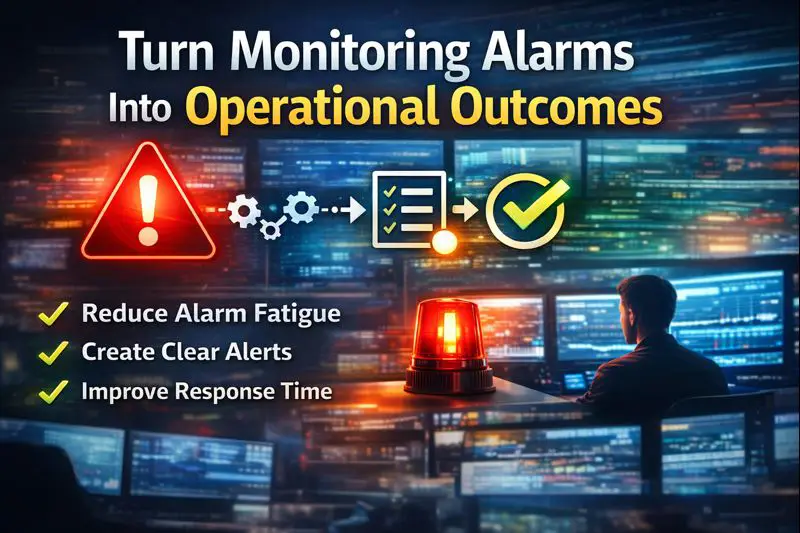
Let's review why monitoring "works" technically but fails operationally. We'll then talk about how to design your monitoring system so that alarms create actual outcomes: faster response, fewer repeat incidents, and fewer "how did we miss that?" moments.
The guidance I'm sharing here is for network operations leaders, NOC managers, critical infrastructure teams, and technical executives who already collect plenty of monitoring data-but still experience slow response, repeat incidents, or avoidable outages. It's written for organizations that want monitoring systems to drive fast, confident action in real-world conditions, not just populate dashboards or generate alerts.
Monitoring data is raw signal: readings, states, traps, logs, thresholds, and events. Operational outcomes are the real-world results those signals should drive: the right person takes the right action fast enough to prevent a service-impacting failure.
A concise way to remember the difference is:
Data is what systems produce.
Outcomes are what organizations experience.
In practice, monitoring should reduce decision time. Monitoring should reduce downtime. Monitoring should reduce the number of second incidents caused by "we fixed the symptom but missed the cause."
If your monitoring creates more activity without reducing incidents, you don't have an information problem. You have an outcomes problem.
Many monitoring environments collect data correctly. Alarms do trigger. Dashboards do update. Yet, your team's response is slow. People hesitate. Heroic interventions from senior staff are required.
That pattern is not a mystery, and it's not typically a hardware failure. It's a design failure about how information becomes action.
Most monitoring systems stop at awareness. Awareness is useful, but awareness is never the same as resolution, and it is definitely not the same as prevention.
When monitoring "fails," what usually actually failed is the operational chain between your first alert and the final fix.
A monitoring signal becomes valuable only when it makes it through all three of these layers:
Raw data is what devices produce: a temperature reading, an AC fail input, a ping loss, a battery voltage, a generator run status, a fuel level. That data then gets passed "northbound" (via an RTU like a NetGuardian or through direct messaging from a device capable of a protocol like SNMP).
Raw data is necessary because it is the input for everything else. Raw data alone, though, can be difficult to interpret in order to take useful action.
Interpreted information adds meaning: this threshold is exceeded, this state is abnormal, this site is down, this alarm is critical, etc.
Many monitoring tools from many different manufacturers can do this layer reasonably well. They can show a red light. They can graph a trend. They can generate alerts.
Operational outcome is the final layer: someone understands the problem quickly, takes the correct step, confirms the impact, and captures what mattered so the next incident is faster-or doesn't happen at all.
The most common monitoring gap is failing to close the loop: not just "did we react," but "did we do what we need to do to prevent it from happening again?" This is something that we've worked really hard on at DPS, including via Trouble Logs, Derived Alarm logic, and "Text Messages" that contain instructions for operators when an alarm occurs. We help you build your organizational knowledge directly into your monitoring system, because that's where it must be in order to actually be used in a stressful emergency situation.
It sounds counterintuitive, but adding more alarms, more dashboards, more color, and more graphs can make outcomes worse if the additional information increases uncertainty or noise.
Monitoring overload causes failures in predictable ways:
A monitoring program that floods humans with unqualified alerts doesn't improve reliability. It increases hesitation.
Alarm fatigue is not a human character flaw on your team. It is what happens when a system repeatedly asks people to care about things that are not actually important.
On day one, teams are motivated. They're bright-eyed and ready to stay on top of the alerts. Then, reality arrives: you can't stare at everything all the time. When the system generates constant noise, the operator starts to feel foolish because the system is not actually important.
That creates muscle memory in a terrible way: clicking past alerts, acknowledging without reading, and dismissing signals that look and sound like "the usual noise."
At that point, alarms stop driving action altogether. If nobody's looking at it, then of course it's not driving action.
A monitoring system is only as good as the trust humans place in it. Protecting that trust requires aggressive nuisance-alarm management.
An alarm that cannot be understood in seconds is operationally useless.
Operational environments are not classrooms. Operators do not have time to decode cryptic abbreviations, interpret truncated text, or guess whether "AC" means air conditioning, alternating current power, or something else entirely.
An actionable alarm label must answer two questions instantly for anyone reading a display screen:
Where is this?
What is wrong?
If the answer isn't obvious at a glance, the alarm will create a slow and risky chain of follow-up questions-especially during nights, weekends, and staff transitions.
When an alert is unclear, the first person who sees it loses time trying to figure out what it means. Unless way too much time is spent decrypting the data at that phase, the alert often gets handed off with remaining uncertainty-kicking the can down the road with an unclear message.
Think of the chain of people you have from the first one to see an alert to the last one to actually fix it. Every weak link in the chain slows response, and that delay increases the risk of service failure.
This is the point where monitoring stops being an "operator problem" and becomes a system design failure.
A well-designed monitoring environment reduces ambiguity. A poorly designed environment exports ambiguity to humans, where it becomes overtime, escalation, and downtime.
Monitoring systems should be designed around real-world human behavior, not ideal behavior.
Even when the alert is correct, it's 2 A.M. and someone doesn't wake up. Or someone wakes up and hesitates because the alert is unclear. Or someone wakes up and is not the right person to fix it.
Outcome-driven monitoring assumes that human operators will have some hesitation and builds a backstop.
Practical escalation patterns include:
Escalation design is not just convenience. Escalation design is reliability engineering.
A monitoring environment is fragile when only one or two people truly know what alarms mean and what to do next. That fragility becomes obvious the day after that person retires, changes roles, or goes on vacation.
Outcome-driven monitoring reduces the bus factor by embedding knowledge into the system:
A simple test exposes hero-dependence fast: have the expert sit off to the side and stay quiet while someone else works from the alarms alone. If your team can't figure out what an alarm is within a few seconds, that's a system problem and not a training problem (especially with the technology we have available today).
Data doesn't keep systems online. Clear alarms, embedded judgment, and institutional memory do.
Clear labeling, consistent naming conventions, and "where + what" formatting reduce the time between awareness and action.
In real operations, single signals are often ambiguous. The combination is what matters.
For example, AC power fail may be manageable by itself (perhaps only a "major" or "minor" alarm severity). Low batteries may be manageable by itself. Low generator fuel may be manageable by itself. But AC fail and low batteries and low fuel is about as "critical" as an alarm can get.
That kind of combined condition should not require a human to mentally correlate three separate alarms under pressure. It should be encoded as a "derived", high-priority situation that escalates immediately.
One practical way teams do this is by using an alarm collection device at remote sites that supports flexible rules and clean labeling and derived logic-such as a DPS Telecom NetGuardian RTU-and then feeding those normalized, qualified alarms upstream. It's equally possible to handle this logic at the alarm-master layer using a tool like T/Mon.
Many organizations fix an immediate issue and move on. The same failure mode returns because nobody captured what mattered: the real root cause, the correct remediation steps, and the "gotchas" that slowed response.
Institutional memory is the difference between "we always scramble for this" and "we solved this last time, and our system remembers how."
In practice, institutional memory can look like:
A master alarm layer can help centralize that memory and standardize response-especially across mixed-vendor environments. In many telecom and critical infrastructure NOCs, that "alarm master" role is exactly what DPS Telecom's T/Mon is used for: consolidating alarms, applying escalation logic, and presenting operators with consistent, actionable information instead of raw noise.
Outcome-driven monitoring is not about building a more complicated dashboard. It's about removing ambiguity and noise so action becomes obvious.
Here are outcome-oriented changes that reliably improve reliability:
If an operator can't answer "where" and "what" in seconds, rewrite the label. Don't accept cryptic abbreviations or truncated phrases as "good enough."
Use qualification timers, persistence rules, and suppression patterns that prevent transient alerts from training operators to ignore the system.
Some conditions are only meaningful after a duration threshold. A generator "running" is not automatically a crisis. A generator running outside normal windows, or running longer than expected, often is.
Use derived alarms to elevate combinations of conditions that create real risk.
Assume missed alerts happen. Build acknowledgement windows, backstops, and shift-aware routing that still get the right person engaged.
If your organization is standardizing how alarms are displayed, routed, and acted on, a visualization layer can also help keep attention focused on what matters. Many teams pair their alarm master and RTUs with a web-accessible view of current status-such as DPS Telecom T/Mon "Monitor Mode" view-so all stakeholders can see the same prioritized picture.
A surprising truth about monitoring ROI is that the biggest win is invisible: nothing bad happens.
The proof of success is that nothing crazy happens-not because you got lucky, but because your monitoring consistently turned early signals into early action.
Success looks like:
Monitoring is an operations system, not a reporting system. When it is designed for outcomes, it makes reliability feel boring (in the best possible way!).
Monitoring data is what systems produce. Operational outcomes are what organizations experience. Data becomes valuable only when it reliably drives timely, correct action.
Most monitoring systems stop at awareness. They generate alerts but don't reliably reduce ambiguity, speed response, or prevent repeats. The failure is usually in the human-action chain, not in data collection.
An alarm is actionable when it can be understood in seconds and instantly answers: Where is this? What is wrong? Actionable alarms reduce hesitation and reduce handoff friction.
Alarm fatigue happens when a system produces frequent low-value alerts. Operators learn to distrust the system, and alarms stop driving action. Alarm fatigue is a system design problem that requires noise reduction and better qualification.
Escalation should assume occasional missed alerts and hesitation. Use acknowledgement windows, multi-person notification for critical events, shift-aware alert routing, and alarms that continue escalation until someone actually responds by acknowledging the alarm.
A realistic KPI is reduced decision time and fewer surprises. In operational terms, success often looks like "nothing crazy happens" because the system consistently turns early signals into early action.
Now, you understand the difference between raw data and what an ideal monitoring system looks like. No matter where you are on this journey, I (and the other engineers at DPS) can help you plan your next steps. Give me a call or send me an email (or assign that task to someone on your team):

Andrew Erickson
Andrew Erickson is an Application Engineer at DPS Telecom, a manufacturer of semi-custom remote alarm monitoring systems based in Fresno, California. Andrew brings more than 19 years of experience building site monitoring solutions, developing intuitive user interfaces and documentation, and opt...