Download our free Monitoring Fundamentals Tutorial.
An introduction to Monitoring Fundamentals strictly from the perspective of telecom network alarm management.
1-800-693-0351
Have a specific question? Ask our team of expert engineers and get a specific answer!
Sign up for the next DPS Factory Training!
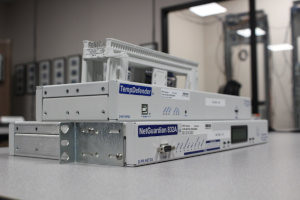
Whether you're new to our equipment or you've used it for years, DPS factory training is the best way to get more from your monitoring.
Reserve Your Seat TodayGaston County, a municipal county government in Southwest North Carolina, needed reliable remote alarming for vaccine refrigerators and critical building equipment across multiple facilities. By deploying DPS Telecom AlphaMax and DPM alarm remotes, the Public Works team improved alarm delivery flexibility and enabled faster response to after-hours issues.
| Industry | Municipal government and public facilities |
|---|---|
| Company Type | County government (Public Works support for jail, courthouse, and medical clinics) |
| Geography/Coverage | Southwest North Carolina |
| Primary Challenge | Replace an older alarm remote with limited paging capacity and a hard-to-source annual battery replacement requirement |
| Solution Deployed | Standalone monitoring and alarming using 2 DPM alarm remotes and 1 AlphaMax alarm remote, with alerts delivered directly to staff |
| Key Result | More flexible notifications (email, text, and alphanumeric paging where needed) and earlier response to temperature and equipment issues |
| Products Used | DPM alarm remote (2 units); AlphaMax alarm remote (1 unit) |
Gaston County operates on behalf of nearly 200,000 residents in Southwest North Carolina. Barry Styers, a maintenance technician with the Gaston County Public Works department, helps maintain municipal facilities and supports the staff and public who rely on those buildings every day.
To reduce risk from equipment failures, Styers uses remote monitoring to keep watch over multiple types of critical assets in the county's jail, courthouse, and medical clinics.
Styers previously used an alarm remote that had several limitations. It could only send alphanumeric pages to two different pagers, which forced the county to rely on a paging system to forward messages to multiple technicians. The older unit also required a battery replacement every year. Over time, sourcing that battery became a problem.
"We couldn't get those batteries anymore, so we decided it was time to get a better system."
In addition to overcoming hardware constraints, Gaston County needed a practical way to notify the right people based on the type of alarm and the equipment being protected, including temperature-sensitive vaccine storage.
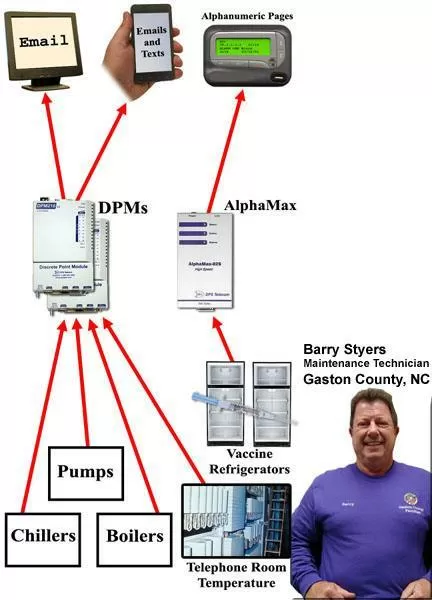
Styers upgraded to DPS Telecom alarm remotes that can deliver alarms through multiple notification paths. "Now, I have 2 DPMs and an AlphaMax," he says. The AlphaMax is used to monitor vaccine refrigerators, while the DPM units are used for broader building and facility monitoring.
For organizations that need straightforward monitoring without building out a centralized network management system, DPS Telecom standalone alarming is often a good fit. Alarm remotes typically connect to dry contact closures (discrete alarm points) and can also accept analog inputs from sensors such as temperature probes. When a point goes into alarm, the unit automatically sends the configured message to the appropriate recipients.
Gaston County's deployment also illustrates a common best practice: use email and text for rich, immediately readable alarm details, while keeping alphanumeric paging available for staff or departments that still depend on pagers.
Gaston County used the AlphaMax to monitor vaccine refrigerators. Vaccines are sensitive to temperature fluctuations or prolonged exposure to room temperatures, so early warning is critical. With temperature monitoring in place, technicians can respond at the first sign of a refrigerator moving out of the standard storage range.
"I haven't had any trouble with the AlphaMax. It's working really well," Styers adds.
Styers uses the DPM units to monitor facilities in the county jail and courthouse. "With the DPMs, I'm monitoring boiler and chiller failures, pump failures, some telephone equipment rooms - high temperature alarms," he says.
By monitoring building systems, Styers can make sure he, or another technician, responds early to failures that could potentially affect employees and citizens in the county jail or courthouse. After-hours HVAC problems were a key example.
"We've gotten some late-night chiller failures, and those can't wait until morning. The DPMs send me an email or text, and I can run out there and start them up - before anything gets too hot."
With the DPM units and AlphaMax, Styers also gained more flexible alarm notification options. "I get email on most alarms," he says. With email, he does not have to carry a separate pager or decipher short alphanumeric messages, and the alert can include the information needed to act quickly.
At the same time, the ability to send a page remains valuable: "Some of the people at the Health Department still have pagers, and for a few of the alarms, we just send them an alphanumeric page." In practice, the DPM and AlphaMax units give Gaston County a way to automatically send the right alarm messages to the right people at the right time.
Vaccine storage is temperature-sensitive. Remote alarming provides early warning when temperature conditions drift toward unacceptable ranges so staff can respond before vaccines are compromised.
Common points include HVAC status (chillers, boilers), pump failure contacts, and temperature alarms in spaces such as telephone equipment rooms. Many monitoring devices also support sensor inputs where measured values (like temperature) must be tracked.
Some departments still use pagers for on-call coverage. A mixed notification approach lets you reach each group using the method that best fits their workflow.
Not always. As this deployment shows, standalone alarm remotes can send alerts directly to technicians. If your organization later needs broader oversight across many sites, adding centralized alarm management (such as T/Mon) can consolidate visibility and escalation.
If you are responsible for protecting temperature-sensitive assets, facility systems, or critical communications rooms, DPS Telecom can help you design an alerting approach that matches your staffing and escalation needs. Get a Free Consultation or call 1-800-693-0351 to speak with an expert about your project.