Download our free Monitoring Fundamentals Tutorial.
An introduction to Monitoring Fundamentals strictly from the perspective of telecom network alarm management.
1-800-693-0351
Have a specific question? Ask our team of expert engineers and get a specific answer!
Sign up for the next DPS Factory Training!
Whether you're new to our equipment or you've used it for years, DPS factory training is the best way to get more from your monitoring.
Reserve Your Seat TodayStartec Global Communications needed a single, operator-friendly view of alarms across VoIP and TDM switching and transport equipment in multiple cities. Using DPS Telecom's T/Mon platform and NetGuardian 832A RTUs, the NOC team centralized visibility, filtered alarms by severity, and added door and environmental monitoring.
Read part 1 - How Startec Global Communications Monitors Their International Network.
| Industry | Telecommunications (VoIP and TDM voice services) |
|---|---|
| Company | Startec Global Communications |
| Company Type | Carrier and service provider (wholesale and retail traffic) |
| Geography / Coverage | Multi-site network including Miami, New York, Los Angeles, Vancouver, and Toronto |
| Primary Challenge | Provide NOC-wide, top-level monitoring for diverse network elements and alarm sources while keeping operators focused on actionable events |
| Solution Deployed | Centralized alarm management with T/Mon platform; discrete and environmental alarming with NetGuardian 832A |
| Key Result | Overall network view with severity-based filtering and centralized visibility for circuit and equipment alarms |
| Products Used | T/Mon platform; NetGuardian 832A |
Walid Karim is the NOC manager at Startec Global Communications. "I take care of day-to-day operations in the NOC, including the employees and network," Karim said. "I make sure that our network is optimal at all times. We're quite busy."
Startec's network includes multiple types of switching and transport systems. "We have a softswitch, a GSP switch, and DACSes and fiber muxes," he said. "We're mostly running VoIP & TDM for the domestic and international calls that we're terminating, including both wholesale and retail traffic."
For a busy carrier NOC, the operational problem is not simply collecting alarms - it is making sure the right alarms get to the right people quickly, without burying technicians in low-priority noise.
Startec needed top-level monitoring that could roll up alarms from multiple equipment types (softswitches, switching systems, DACSes, and fiber muxes) deployed across several North American sites. The NOC also required visibility into physical-site conditions, such as door status and environmental/power conditions, which often become the first indicators of service-affecting events.
Startec uses T/Mon as their top-level master. "We use T/Mon as a monitoring tool to monitor our Sonus softswitch and our GSP switch," Karim said. "It also monitors DACSes and fiber muxes in Miami, New York, LA, Vancouver & Toronto sites."
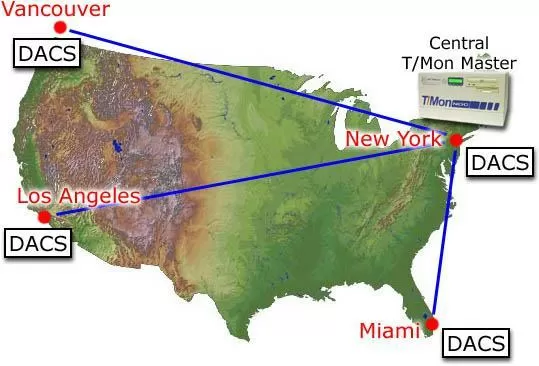
In practical terms, this approach gives the NOC a single place to view alarm activity across key voice and transport systems. "T/Mon gives us an overall view of our network," he continued. "Any time we have a circuit go down, we'll see those alarms. Whether they are GSP alarms, Soft switch alarms DACS or Fiber mux alarms."
To support the physical monitoring layer, Startec also deployed DPS Telecom RTUs for discrete and environmental alarming. "The T/Mon collects alarms via LAN," Karim said. "We also have NetGuardian 832A's for door alarms and environmental alarms like humidity and power failures."
"The thing that makes it easier is the support that DPS has. I know that, if I run into an issue, I can always count on their support."
From an engineering perspective, this is a common architecture: T/Mon acts as the centralized alarm presentation, filtering, and routing layer, while NetGuardian RTUs concentrate site-level inputs (door contacts, power failure indications, and environmental sensors) and forward actionable notifications to the master station.
No-Fee Factory Training Delivers "a Lot of Information" in 4 Days
Karim attended DPS Factory Training to gain more familiarity with T/Mon after taking over the responsibilities of a previous NOC manager. "I took over the responsibilities of the previous NOC manager. He used to take care of the T/Mon configuration," Karim said. "I've never had the opportunity to get into the T/Mon. I've looked at the alarms, but not as far as configuring and setting it up."
"I like the structure of the class. It provides a lot of information, especially for someone who's new to T/Mon and NetGuardians."
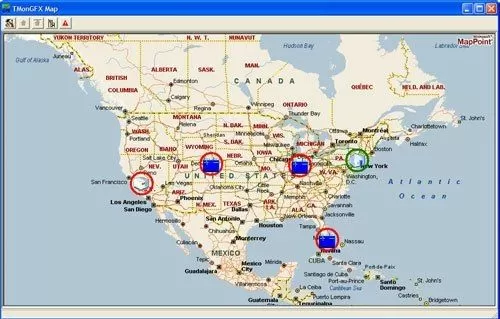
While at training, Karim also saw the T/GFX monitoring interface and wanted to pursue it after returning home. "We use T/Windows to monitor our T/Mon," he said. "I saw T/GFX at training and I was very much interested. Once I go back home, hopefully I can set up T/GFX there. It's similar to what we use for IT monitoring. We're used to that."
For Karim, paying no tuition to attend training was a key advantage. "Training was free. That was the 'Number One' thing," he said.
He also appreciated the organization and content of DPS Factory Training. "I like the structure of the class," said Karim. "It provides a lot of information, especially for someone who's new to T/Mon and NetGuardians."
With T/Mon serving as the master monitoring tool, Startec gained centralized visibility across switching and transport elements and could quickly see service-impacting events such as circuit outages. T/Mon's ability to normalize incoming events and filter by severity helped keep the NOC focused on alarms that matter most during high activity periods.
By adding NetGuardian 832A units for door and environmental alarming, the NOC also improved awareness of facility conditions that can drive or precede network outages, such as humidity and power failures.
If you are building a similar architecture, DPS Telecom typically recommends using T/Mon to consolidate and present alarms across your core network, paired with NetGuardian RTUs at remote sites to bring in contact closures, analog sensors, and site-status points over IP.
It is the central system where alarms from many devices and sites are collected, normalized, and presented to operators. In this case study, Startec uses the T/Mon platform as the master monitoring tool.
TL1 alarms are often delivered as text messages from telecom equipment. A system like T/Mon can use text processing to convert those messages into structured alarms that can be filtered, displayed, and routed based on severity.
Site conditions can directly impact uptime. Door alarms, humidity, and power failure indications help technicians correlate facility events with network alarms and speed dispatch decisions.
They are operator interface options used to view and interact with alarms managed by T/Mon. Startec noted using T/Windows and expressed interest in adding the T/GFX interface for a geographic view.
To receive a price quote, a ROI analysis, or help scoping a T/Mon and NetGuardian monitoring design...
Call 1-800-693-0351