Download our free Monitoring Fundamentals Tutorial.
An introduction to Monitoring Fundamentals strictly from the perspective of telecom network alarm management.
1-800-693-0351
Have a specific question? Ask our team of expert engineers and get a specific answer!
Sign up for the next DPS Factory Training!
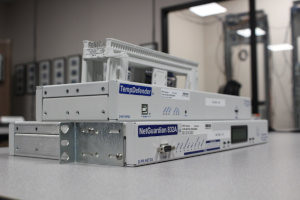
Whether you're new to our equipment or you've used it for years, DPS factory training is the best way to get more from your monitoring.
Reserve Your Seat Today
TBayTel, a telecommunications provider serving Northern Ontario around Thunder Bay, is planning monitoring improvements to help keep remote sites secure, online, and supportable. Network Planner Jim Mackenzie is evaluating DPS Telecom NetGuardian RTUs and T/Mon LNX alarm management software to consolidate site alarms, environmental visibility, and out-of-band access for faster response.
| Quick Facts | Details |
|---|---|
| Industry | Telecommunications |
| Company | TBayTel |
| Company Type | Regional communications service provider (telephone, Internet, television, and cellular) |
| Geography / Coverage | Northern Ontario around Thunder Bay - approximately 300,000 square kilometers |
| Primary Challenge | Secure sites with proper alarms and environmental monitoring; maintain real-time power and generator status; reduce blind spots across a large footprint |
| Solution Deployed | Evaluation of NetGuardian RTUs for discrete and analog monitoring with alerting and multi-manager SNMP reporting; planned use of T/Mon LNX and T/GFX for centralized alarm visualization and northbound SNMP to an existing Manager of Managers (MoM) |
| Key Result | Improved site visibility for proactive maintenance and faster dispatching, while preserving existing upstream monitoring and trouble ticketing workflows |
| Products Used | NetGuardian 832A G5; T/Mon LNX; T/GFX |
Jim Mackenzie supports network planning for TBayTel by working with marketing to determine what services to offer and then designing how those services will be provisioned, operated, managed, and supported. With a service area spanning a region slightly larger than Arizona, reliable remote site operations are a foundational requirement for high service quality and throughput.
"It's hard to build a reliable network if you can't first rely on having secure sites, with proper alarms and environmentals."
TBayTel's planning focus includes making sure remote sites stay online and operational to maximize uptime. Mackenzie notes that without strong control and visibility at the site level, it is difficult to maintain a high-quality network.
In particular, TBayTel experiences rotating commercial power outages in parts of its network. For dispatching technicians effectively, the organization needs real-time awareness of power and generator status at remote sites, along with the environmental conditions that can impact equipment health.
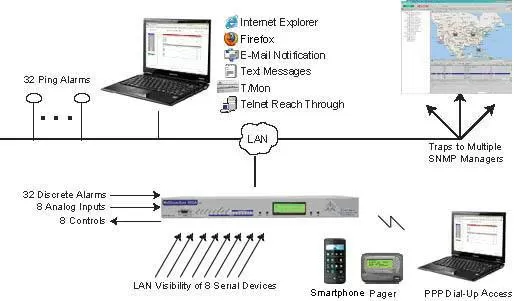
To close monitoring gaps at remote locations, Mackenzie is looking to deploy DPS Telecom remote telemetry that can consolidate multiple monitoring disciplines into a single device. The goal is to collect discrete alarms (such as door contacts and other dry contact points) and analog measurements (such as temperature and power readings) and then deliver those signals to operations staff in a way that supports both immediate response and proactive maintenance.
This approach aligns with how many telecom operators use DPS Telecom systems: place a NetGuardian RTU at the site edge to gather alarm and telemetry data, then send that information to one or more network management systems over SNMP, while also generating direct notifications (for example, email or pager) for rapid awareness. When paired with centralized alarm management software such as T/Mon LNX, these site-level signals can be normalized and presented to the NOC as actionable alarms with clear context.
Mackenzie summarizes the requirement this way: "If you don't have good control of your sites, it'd be hard to maintain a quality network through them." He points to DPS Telecom RTU consolidation as a way to simplify monitoring design and reduce blind spots. "What I like about DPS equipment is that you can do all your dry contact alarms, door alarms, and temperature and power monitoring discretely in one RTU. But more important is analog trending - towards proactive maintenance," he says.
Analog trending matters because it changes monitoring from a binary state (good/bad) to an operational signal that can show drift over time. In a typical deployment, trending can highlight increasing temperatures, degrading battery voltage, or other gradual changes before they become a service-affecting outage. For TBayTel, this capability is part of building remote visibility into "environmentals properly, and even to preempt certain problems."
Effective monitoring enables a proactive maintenance posture by turning site conditions into real-time information for dispatch and escalation. As Mackenzie explains: "We suffer rotating commercial power outages in some parts of our network and we need to know our sites' Power and Generator status on a real time basis as far as dispatching techs goes." With the right discrete and analog monitoring, operators can detect when a generator switches on and maintain awareness of remaining fuel or battery runtime.
For a geographically large network, this kind of real-time status helps ensure the right technicians and equipment are sent to the right locations. It also supports consistent operational decisions when multiple sites are impacted at the same time.
"RTUs provide good remote visibility and, at the same time, an Out Of Band path to use to restore the network, if the primary network is down."
In addition to alarm and environmental monitoring, Mackenzie notes an intent to establish an out-of-band (OOB) management network that is separate from customer networks. In practice, an OOB design is often used to preserve management reachability when the production path is impaired.
To support that intent, he is looking at Remote Test Units that support multiple means of transport, such as the NetGuardian G5 series remotes. These RTUs also incorporate a terminal server function to provide craft and console access to remote devices. This combination - site monitoring plus an alternative access path - is a common reason telecom operators select DPS Telecom RTUs for remote sites: they provide a single platform for collecting alarms and, when needed, supporting remote recovery steps.
"The graphical functionality of the T/Mon means we'll have better dispatching coming out of the NOC."
TBayTel is also planning to use T/Mon to simplify alarm management across the network. Mackenzie explains that it will provide a graphical display for teams in the NOC and regional operations. With map-based visualization, staff can use visual cues to locate the affected area and quickly decide where to drill down and where to dispatch technicians.
With T/GFX, operators can see where alarms occur directly on a map and navigate through layers down to a site floor plan. This helps reduce time spent correlating an alarm to a physical location during an incident. Mackenzie notes that this improves dispatching because staff can interpret alarms with clearer geographic and site context.
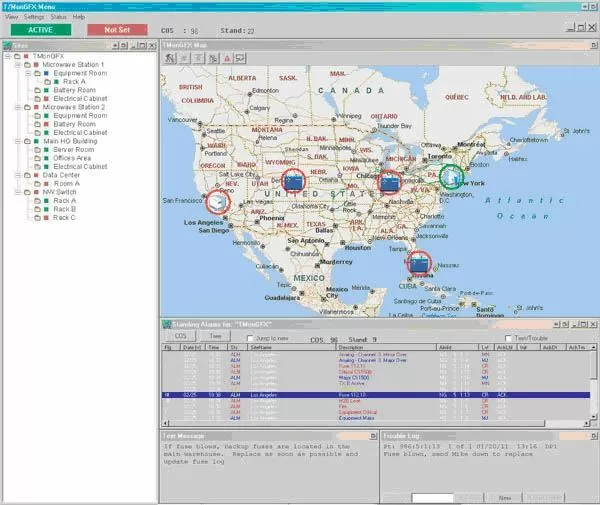
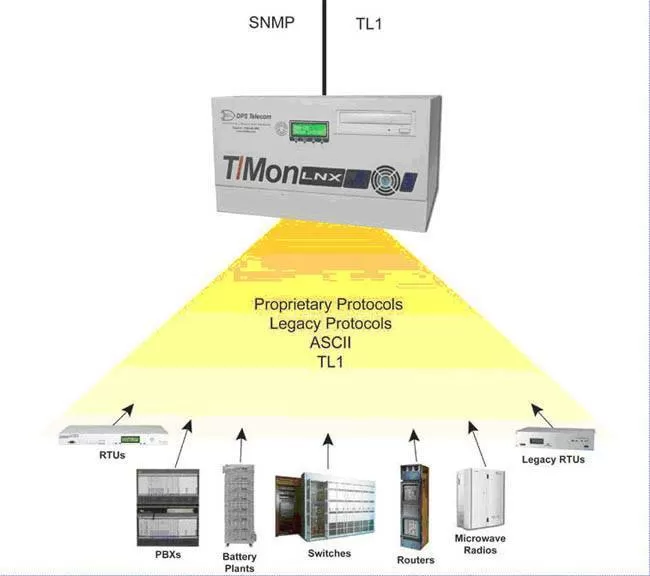
Another driver is protocol coverage. Mackenzie notes that because T/Mon can parse TL1 and ASCII alarms, it can be used to monitor virtually the entirety of TBayTel's physical network. In many deployments, this type of multi-protocol ingestion allows operators to centralize alarms from mixed-vendor equipment, while still standardizing how alarms are displayed, filtered, and escalated.
T/Mon is also being evaluated for fit with TBayTel's current monitoring processes. "We intend to run the T/Mon LNX with a northbound SNMP feed into our current Manager Of Managers (MOM), and doing our trouble ticketing that way," Mackenzie says.
TBayTel already uses a Manager of Managers that connects to a trouble-ticketing system. The team does not want to lose that upstream integration or create separate, competing alarm views. Because T/Mon can output SNMP as well as ingest alarms from site RTUs and other sources, it can be positioned as an alarm concentration and normalization layer while still sending a northbound SNMP feed to the existing MoM.
"By meeting with the DPS staff, you can figure out the art of the possible, and learn where DPS wants to take their technology, because you want to get there with them."
Mackenzie attended a factory training event at DPS Telecom headquarters in Fresno, CA to learn more about T/Mon and its capabilities. During the training, he worked with live DPS equipment in the classroom and gained a deeper understanding of how the platform can be extended, including capabilities such as derived alarms.
He also toured DPS Telecom facilities and met members of the design, engineering, and production teams. The combination of hands-on training and direct access to subject matter experts helped clarify what is achievable and how planned monitoring strategies can evolve as requirements grow.
An RTU (Remote Telemetry Unit) gathers signals at a remote site - such as door alarms (dry contacts), temperature, power readings, and IP reachability (ping) - and reports them to operations tools, commonly via SNMP.
Threshold alarms tell you when a limit has been crossed. Trending shows whether a value is gradually changing over time, which can support proactive maintenance planning before service is affected.
T/Mon can ingest alarms from RTUs and other systems, then send a northbound SNMP feed to an upstream MoM. This can preserve existing ticketing and enterprise monitoring workflows while centralizing alarm handling and visualization.
Out-of-band management uses a separate path from the primary customer network so operators can still access devices and troubleshoot when the production network is unavailable.
In addition to SNMP-based alarms from RTUs, T/Mon can work with other alarm sources (including TL1 and ASCII, as noted in this case) to help centralize and standardize how alarms are presented and escalated.
If you are planning improvements to site security, environmental visibility, power monitoring, or out-of-band access across a distributed network, DPS Telecom can help you design a monitoring approach that scales. Get a Free Consultation or call 1-800-693-0351 to speak with a DPS Telecom expert about your project.