Check out our White Paper Series!
A complete library of helpful advice and survival guides for every aspect of system monitoring and control.
1-800-693-0351
Have a specific question? Ask our team of expert engineers and get a specific answer!
Sign up for the next DPS Factory Training!
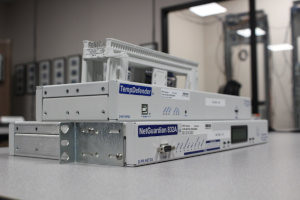
Whether you're new to our equipment or you've used it for years, DPS factory training is the best way to get more from your monitoring.
Reserve Your Seat TodayEnvironmental threats can take out an entire rack of equipment at once. A temperature spike, a water leak, or an HVAC failure at an unattended site may go undetected for hours, until the damage is already done.
At DPS Telecom, we've helped 1,500+ organizations build remote environmental monitoring systems tailored to their specific sites, infrastructure, and protocols. Our equipment is designed and manufactured in Fresno, CA, with 172,800+ devices deployed across telecom, utilities, government, and transportation.
Talk to an Engineer or call 800-693-0351
"Environmentals" typically means temperature and humidity, but a complete monitoring system covers more than that.
| Condition | Why It Matters |
|---|---|
| Temperature | Equipment overheating is one of the most common causes of unplanned failures at unattended sites |
| Humidity | Condensation causes corrosion and can short-circuit equipment |
| Floor water | Leaks and flooding can destroy entire cabinets before anyone arrives on site |
| Smoke | Early detection before fire suppression activates or damage spreads |
| Airflow | HVAC performance monitoring; detects clogged filters or failed fans |
| Door contacts and motion | Unauthorized access is an environmental threat too |
Each of these conditions is monitored by sensors connected to a Remote Telemetry Unit (RTU), which sends alarms back to your team the moment a threshold is crossed.
A remote environmental monitoring system has three layers:
Each layer can be configured independently. Some organizations already have an SNMP manager or SCADA platform in place. Our NetGuardian RTUs report to those systems via standard protocols including SNMP, DNP3, and Modbus, so you're not required to replace anything that's already working.
See the NetGuardian RTU Family
Our sensor portfolio uses industry-standard 0-5VDC and 4-20mA interfaces, which means they connect directly to our RTU platforms without custom wiring or converters.
We manufacture our own D-Wire sensors for tight compatibility with NetGuardian RTUs, and we also resell a range of third-party sensors at competitive prices. Most sites require fewer than 10 sensors total.
Common sensor types available:
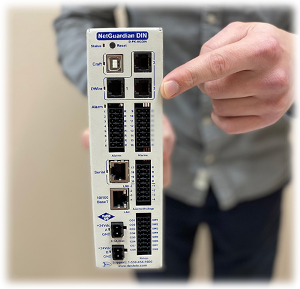
NetGuardian RTUs are the hardware that sits at your remote site, connects to your sensors, and sends alarms. They support discrete inputs (contact closures), analog inputs (0-5VDC, 4-20mA), and protocol-based data collection from third-party equipment.
Specialized models include:
All NetGuardian units support Ethernet connectivity, configurable alarm thresholds, and web UI access for local configuration. Transport options include serial, T1, fiber, GSM/CDMA, and dial-up for sites without reliable Ethernet.
Talk to an Engineer or call 800-693-0351
A well-configured environmental monitoring system doesn't just tell you when something has failed. It warns you before conditions become critical.
For example, you might set a "minor" temperature alarm at 85°F and a "major" alarm at 95°F. When the minor alarm triggers, your team knows there's a developing issue. By the time the major alarm fires, they're already responding rather than reacting to a failure.
This same tiered threshold approach applies to:
The goal is to give your team enough lead time to act without requiring a truck roll for every routine reading. For a deeper look at how this works in practice, see our guides on stopping remote site overheating events and monitoring environmental conditions best practices.
DPS Telecom environmental monitoring systems are deployed across industries where site failures have real consequences:
| Industry | Typical Application |
|---|---|
| Telecommunications | Cell towers, equipment shelters, huts, COLOs |
| Electric utilities | Substations, generation sites, distribution points |
| Government and public safety | 911 centers, radio tower sites, emergency services infrastructure |
| Transportation | Rail, transit, airport facility monitoring |
| Healthcare | Equipment rooms, server environments, critical care facilities |
Whether you're managing 4 sites or 4,000, the system architecture scales without changing platforms.
Talk to an Engineer or call 800-693-0351
Environmental conditions can affect every piece of equipment at a site simultaneously. A single overheating event can damage an entire rack. A slow water leak can destroy equipment over days without triggering any device alarm, because the devices themselves don't monitor the floor.
That's why monitoring environmental conditions separately from equipment alarms matters. Your servers and radio gear may report their own faults, but they won't tell you the temperature is climbing because the HVAC unit failed.
As DPS Telecom CEO Bob Berry writes in 100% Uptime: "Environmental threats can affect everything at your site at once."
For more on building out coverage at your sites, see our guides on planning a humidity monitoring system for remote sites and choosing the best environmental monitoring solution for unmanned sites.
Talk to an Engineer or call 800-693-0351
Remote environmental monitoring is the continuous tracking of physical conditions at an unattended site, including temperature, humidity, water, smoke, airflow, and physical access. Sensors feed data to an RTU, which triggers alarms when readings exceed configured thresholds.
NetGuardian RTUs support SNMP (v1, v2c, v3), DNP3, Modbus, TL1, and 30+ additional protocols. If your existing SNMP manager or SCADA platform needs a specific protocol, contact us and we can confirm compatibility.
Yes. NetGuardian RTUs commonly report to third-party SNMP managers and SCADA platforms. If you prefer a centralized DPS-managed solution, our T/Mon LNX alarm master aggregates environmental alarms from all sites in a single interface.
Most remote sites use fewer than 10 sensors. Common configurations include temperature, humidity, floor water detection, and door contact sensors. Larger or more complex sites may add smoke detection, vibration, airflow, or gas detection.
Yes. We offer a 30-day loaner program. You pay shipping only. This lets you test the equipment in your actual environment before committing to a deployment.
Every monitoring system we build is configured to your site requirements. There are no NRE (Non-Recurring Engineering) fees for custom modifications when you meet minimum order quantities.
Describe what you're monitoring and how many sites are involved. We'll recommend a configuration and, if needed, send a trial unit.
Contact DPS Telecom or call 800-693-0351